
Everything FlowByFlow does
A medication app that takes delivery, honesty and privacy seriously — and does not meter the thing you came for.
No cap on your medication list
The list is not metered. Add as many medications and supplements as you take, on any mix of schedules, without running into a tier boundary.
Reminders and delivery
Schedules built for real prescriptions
Daily, specific weekdays, every N days, or only as needed — whatever the label says. Snooze when the moment isn't right; the durations on offer behave the way you'd expect.
Delivery you can check
Reminders are rebuilt to survive reboots and a closed app. If notifications get switched off or the system throttles them, the app raises a banner and walks you through your phone's battery settings.
A schedule with room to breathe
A softened default reminder chain instead of a barrage, and a dose only counts as missed after a full day — quietly, with no guilt-trip notification.
A 3 a.m. dose still belongs to tonight
A course dosed every few hours puts one of them in the small hours. Set when your day begins — the default is 4 a.m. — and a dose before that time stays with the night you're still in, not a day that hasn't started yet, on Today, in your history and in your cycle log alike.
Quiet the channel you don't want
Medication, cycle, inventory and prescription alerts each have their own switch — turn one off without losing the others.
A medicine's whole lifecycle, not just today's dose
Mark it, fix it, look back
Mark a dose taken, skipped or snoozed, edit it afterwards if you logged it wrong, and check your recent history whenever you need to.
Courses
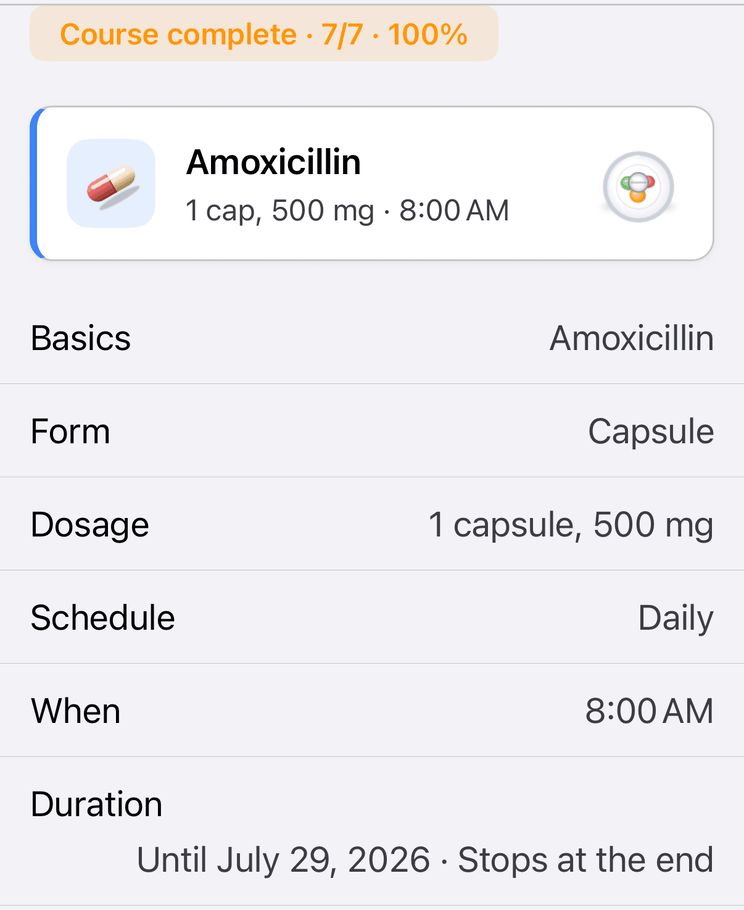
Set an end for the course and the app tracks it to the last dose, then tells you how it went and asks whether to resume it or close it out.
Inventory and refills
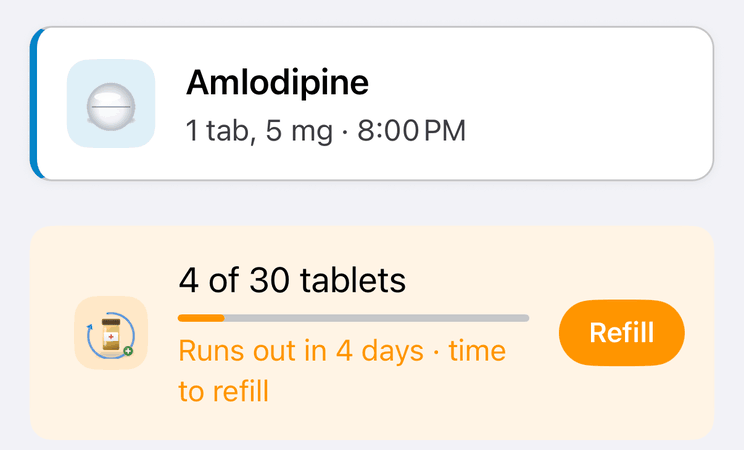
It counts what's left in the box, in days rather than pills, and warns you while there's still time to act. A missed dose doesn't touch the count; a refill adds to what's there instead of replacing it.
A nudge before the prescription runs out — not after
Anchor the renewal reminder to a date, to the day your supply runs low, or to the end of a course. Refill the box or resume the course and the reminder moves with it — no extra step.
Before food, with food, after food
Set how a medicine relates to food and the reminder says so. Record what you actually did when you take it, including on an empty stomach, so your log matches the day rather than just the plan.
A warning when doses land too close
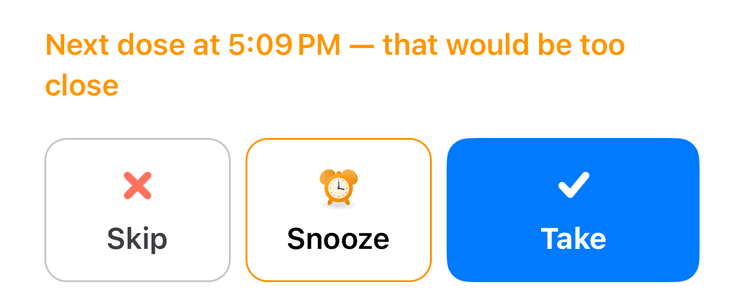
If a dose would land too close to the last one, the app says so before you log it — not after — and offers to skip the next dose to keep the gap. Marking several doses done at once holds back any that would land too close until you confirm them on purpose, and snoozing can't quietly walk you into the next dose either: any option that would land too close is removed from the list. This watches each medicine against its own schedule; it does not check interactions between different drugs.
One place for what needs attention
Courses ending, stock running low, a prescription due, a cycle event — Action Center collects them in one list instead of scattering badges across the app.
If your cycle drives the schedule
Ordinary reminders can only repeat on a calendar. If what you take depends on where you are in your cycle, FlowByFlow can bind the schedule to specific cycle days, to a phase, or to a set number of days before your period or after ovulation — instead of the calendar. It needs at least one logged period and cycle tracking turned on; with no cycle data yet, a cycle-bound medicine simply produces no doses. Its predictions show their uncertainty rather than inventing a date.
Nothing to leak, because it isn't centralized
Private by architecture
Local-first: your data lives on your device and the app works fully offline. There is no advertising SDK in the app, it never asks for your location or region, and there is no advertising profile of you for anyone to buy.
Your lock screen doesn't have to announce what you take
Turn on the option in Settings and every notification the app sends — reminders, low-stock alerts, all of it — drops the medicine name from the preview, on iOS and Android alike.
iOS and Android
The same product on both platforms, in English and Russian.
Coming next
Health trackers, sharing with family and carers, doctor-ready PDF and CSV reports, grouped reminders for a whole time slot, dark mode, and wearable sync from Oura, Apple Health and Health Connect. They're in the build but not switched on yet — this page only lists what you get today.